
my Jesus
“Imagine yourself as a living house. God comes in to rebuild that house. At first, perhaps, you can understand what He is doing. He is getting the drains right and stopping the leaks in the roof and so on; you knew that those jobs needed doing and so you are not surprised. But presently He starts knocking the house about in a way that hurts abominably and does not seem to make any sense. What on earth is He up to? The explanation is that He is building quite a different house from the one you thought of - throwing out a new wing here, putting on an extra floor there, running up towers, making courtyards. You thought you were being made into a decent little cottage: but He is building a palace. He intends to come and live in it Himself.” - C.S. Lewis
I’ve spent most of my life untangling my relationship with Jesus — or maybe more accurately, with the version of Him I was handed as a child. This isn’t a story about leaving faith or finding it again in some conventional way. It’s a story about coming home. About the body. About repair. About the quiet, holy places where fear loosens its grip and love finally takes its rightful seat.
—
To say that the topic of Jesus and Christianity has been complex and multifaceted throughout the course of my life would be an understatement.
I grew up in the Catholic Church. And while there’s so much that I genuinely appreciate about my upbringing—the seeds that were sown, the rituals, the beauty of stained glass and quiet prayer—there was also deep confusion. I learned, almost by osmosis, that the kingdom of God was somewhere outside of me. Up in the sky. Guarded by a man on a throne who I needed to obey. Who held forgiveness in his hands like a currency I had to earn.
I remember standing in the confession line as a little girl, maybe eight or nine years old. My knees shook. My heart pounded. I didn’t really understand what sin was supposed to be, so I would make something up—“I was mean to my sister”—because what lived inside me felt too dangerous to name. Behind closed doors, there were things I couldn’t say. The trembling in my body knew truths my mouth could not form.
It didn’t take long to learn the unspoken rules: to stay safe, I had to abandon myself. To place men on pedestals. To swallow my voice. To bow low and whisper prayers into the void, hoping someone out there might hear me. The only message I ever really received was: pray harder. Read your Bible. Confess your sins.
But my attention—my wandering, neurodivergent, beautiful attention—made it nearly impossible to sit still with those words. So the shame grew louder. It layered itself like sediment at the bottom of my soul, compacting over the years. And beneath that shame was a body carrying trauma it couldn’t name.
I grew into a young woman who hated herself without knowing why. Who chased love in all the wrong places. Who jumped from one relationship to the next, placing man after man on the pedestal of my worth, hoping one of them might make me feel enough.
From as early as I can remember, the story was mapped out for me: You find a good Christian man. You get married. You have children. You live happily ever after under God’s watchful eye.
That was the script. And I tried so hard to follow it.
After a string of rough relationships in my twenties, I prayed for that “good Christian man.” I tried to contort myself into the box of the good Christian girl—the one who’s devout enough, quiet enough, pure enough to be chosen.
But what I didn’t know then was that parts of me didn’t even know we had a choice.
I entered into my marriage with the best intentions I had at the time, but I made that decision from a place of unworthiness—not from the full aliveness of a woman who knew her worth. Years later, a quiet whisper rose in me. It said, “You can choose to stay… or you can choose to live.”
I had known those words since childhood, scribbled into grade-five journals: to live fully alive. And in that moment, I knew I had to trust the whisper.
I hadn’t stepped inside a church in years, but shortly after making that decision, I found myself in a Sunday service. The theme was baptism. The scripture: “Behold, I make all things new.”
And something in me stirred. This time, not out of fear—not out of the terror of hell or the shame of being “unworthy”—but from a quiet, grounded knowing. I knew it was time.
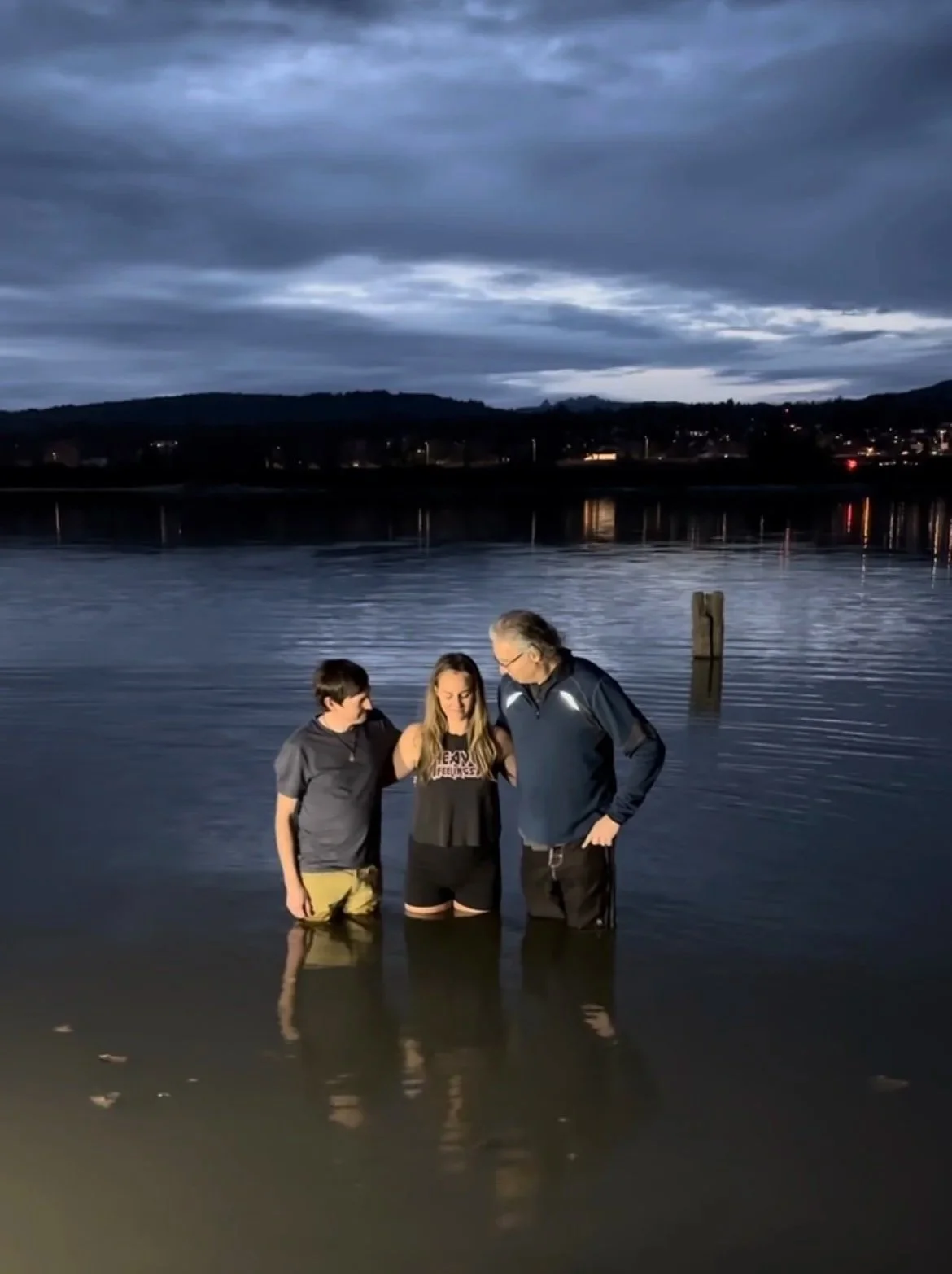
The stars aligned. I met an older couple. And within days, I was standing at the edge of a river in Mission. I could hardly get there fast enough. I didn’t know why. I just knew.
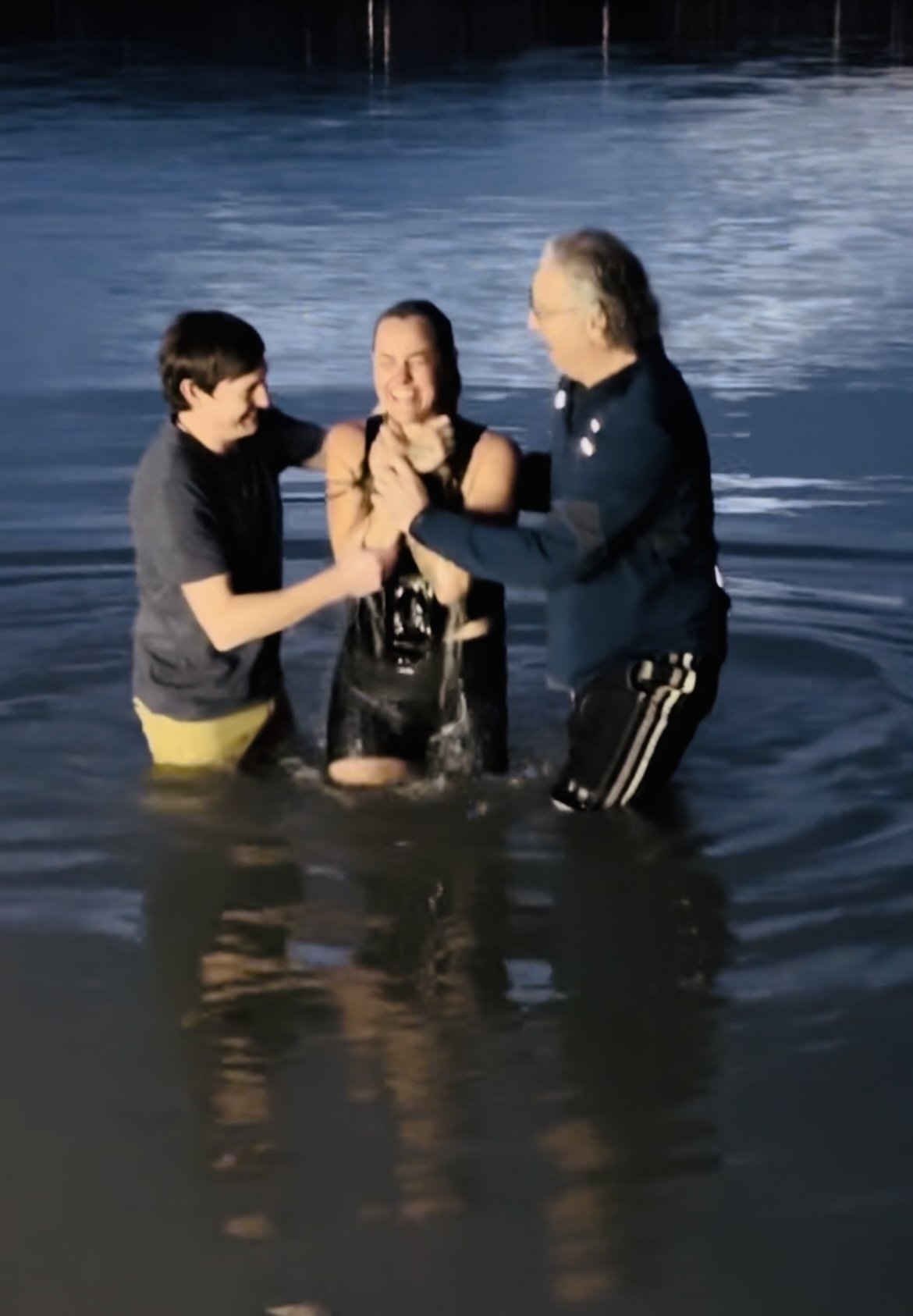
Two men gently lowered me into the water. And in that instant, I understood.
This wasn’t just a baptism. This was a rite of passage. This was repair.
It wasn’t about re-entering the church. It was about restoring my relationship with the masculine—with Jesus, yes, but more deeply, with myself in the presence of men.
For the first time in my life, I wasn’t afraid of God anymore. “Damn right, Jesus,” I thought. “I’ll break bread with you now.”
The church never taught me about the nervous system. It never taught me how impossible it is for a woman who’s been harmed by men to feel safe turning toward a male God in the sky. That wasn’t rebellion. That was survival.
But that day, in that river, something ancient in me was mended.
—
No sermon could have delivered what that river did. The water didn’t ask me to be good. It didn’t demand perfection or penance. It simply held me.
And something in my body—something ancient and trembling—finally exhaled. The little girl who used to stand in confession lines, terrified of a man in the sky, finally felt safe.
That day wasn’t about returning to the church. It was about returning to myself.
For the first time, I didn’t see Jesus as the distant judge hovering above me. I saw him as presence. As love itself. Not power over, but love with. Not a gatekeeper, but a friend.
And it struck me then—how many of us have been asked to kneel before a God who mirrors the faces of the men who hurt us. How many of us have been told to trust what our nervous systems remember as danger. We call it rebellion when women turn away. But most of the time, it’s not rebellion at all. It’s survival.
What happened in that river wasn’t conversion. It was repair. It was my body reclaiming what shame had stolen.
Forgiveness is not about erasing what happened. It’s about holding what hurt and saying, you don’t get to run my story anymore.
This is how the feminine begins to trust again. Not through striving, not through obedience, but through presence. Through coming home to the love that was never outside of us in the first place.
I used to think faith was about climbing ladders to reach a distant God. Now I know it’s about remembering the ground beneath my feet. The river. The breath. The pulse in my chest.
I used to think worthiness was something to earn. Now I know it’s something I already am.
Behold, I make all things new.
- Revelation 21:5
And I used to tremble at the name of Jesus. Now, I whisper it like an old friend’s name. Not above me. Not outside of me. Here. With me. In me.
This is what they never told us — that the kingdom was never in the clouds. It was always inside us, waiting for us to come home.